Do you use your own car for work or business purposes? You may be entitled to claim tax relief on your business mileage or receive tax-free mileage payments from your employer. Understanding how Mileage Allowance works could help you reduce your tax bill and ensure you are claiming the expenses you are entitled to.
Mileage Allowance is one of the most useful tax reliefs available to self-employed individuals and employees who use their own vehicles for work. Rather than calculating every individual motoring expense, eligible taxpayers can use HMRC-approved mileage rates to work out their allowable business travel costs.
With proposed changes to mileage rates attracting attention ahead of the Autumn Budget, now is a good time to understand how the system works and what you can claim.
What Is Mileage Allowance?
Mileage Allowance is a system that allows eligible business journeys made in a privately owned vehicle to be recognised for tax purposes.
Instead of separately calculating fuel, insurance, servicing, repairs and other running costs, a fixed amount can be calculated for each qualifying business mile.
The system is particularly useful for:
- Self-employed individuals and sole traders.
- Tradespeople, including builders, electricians, plumbers and decorators.
- Mobile hairdressers, cleaners and care workers.
- Sales representatives and consultants.
- Employees who travel between different workplaces or client locations.
- Small business owners who use their own vehicles for business journeys.
However, the rules differ depending on whether you are employed or self-employed.
Mileage Allowance Rates for 2026/27
HMRC-approved mileage rates determine how much can be claimed or reimbursed for qualifying business journeys.
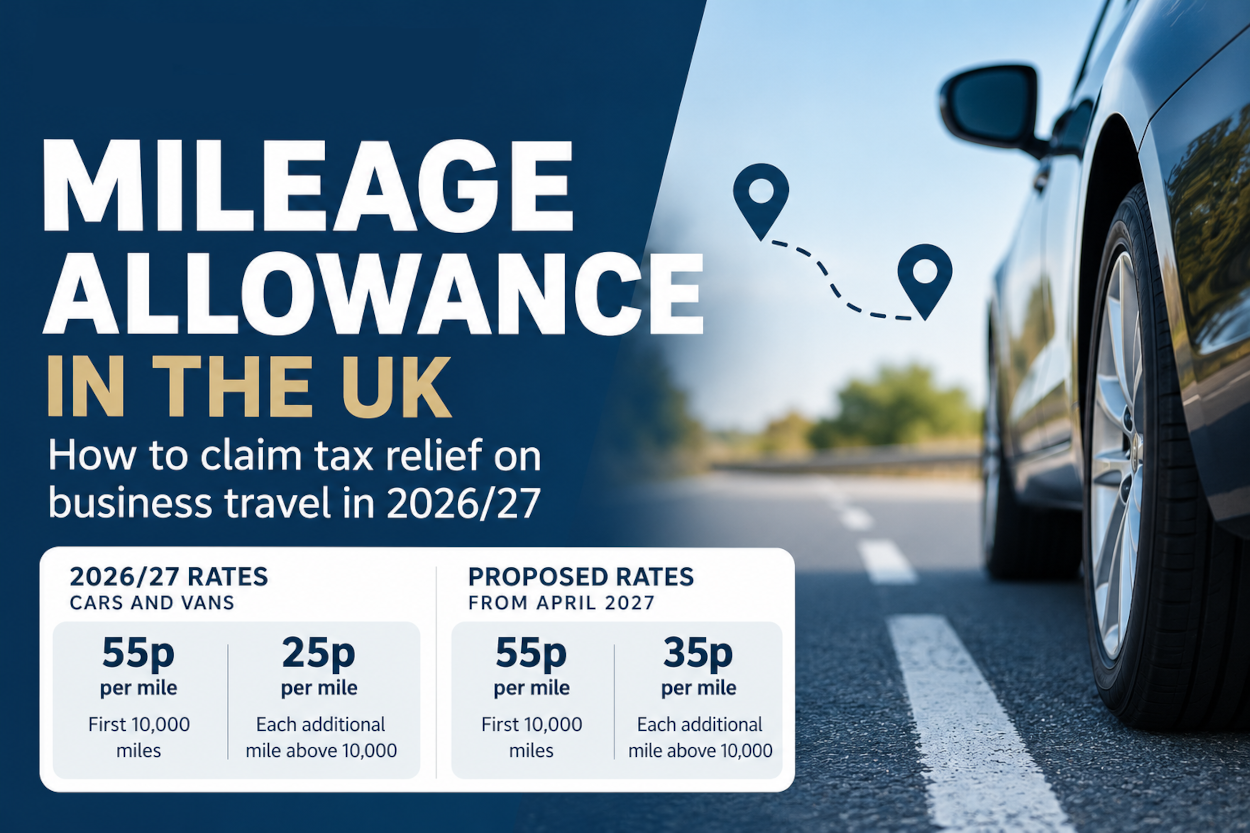
The rates discussed for cars and vans are:
| Business mileage | Rate per mile |
|---|---|
| First 10,000 miles | 55p |
| Each additional mile above 10,000 | 25p |
| Proposed rate above 10,000 miles | 35p |
The Government has announced plans to retain the higher 55p rate and increase the rate for mileage above 10,000 miles to 35p.
Important: The proposed 35p rate should not be used for tax calculations until its effective date and implementation have been confirmed in the relevant HMRC guidance and legislation.
Different rates and eligibility conditions apply to motorcycles and bicycles.
How Does Mileage Allowance Work for Self-Employed Individuals?
If you are self-employed, you may be able to use HMRC’s simplified expenses method to calculate the business costs of using your vehicle.
Rather than claiming individual running costs, you multiply the number of qualifying business miles by the applicable mileage rate.
The resulting amount is treated as an allowable business expense and can reduce your taxable trading profit.
Example: A Sole Trader Driving 12,000 Business Miles
Using the illustrative rates of 55p for the first 10,000 miles and 25p thereafter:
- First 10,000 miles × £0.55 = £5,500
- Remaining 2,000 miles × £0.25 = £500
Total allowable mileage expenses: £6,000
This does not mean HMRC will pay you £6,000.
Instead, the amount is deducted from your business income when calculating your taxable profit, provided the journeys and the chosen expenses method qualify.
The actual tax saving will depend on your overall income, tax band and individual circumstances.
Can Every Self-Employed Person Use Mileage Allowance?
Not necessarily.
The simplified expenses method is generally available to eligible sole traders and partnerships that do not have a company as a partner.
There are restrictions, particularly where capital allowances have already been claimed for the vehicle or another method of calculating vehicle expenses has previously been used.
Limited company directors and employees are subject to different rules, so the correct approach should be considered before making a claim.
Can PAYE Employees Claim Mileage Allowance?
Yes. Employees who use their own vehicles for qualifying business journeys may also benefit from Mileage Allowance.
Employers can reimburse eligible business mileage through Mileage Allowance Payments (MAPs).
Where the payments fall within HMRC’s approved limits, they are generally free from Income Tax and National Insurance.
However, not every employer reimburses business mileage at the full approved rate.
If your employer pays less than the approved amount, or does not reimburse your mileage at all, you may be entitled to claim Mileage Allowance Relief.
Example: Your Employer Pays Less Than the HMRC Rate
Suppose you travel 5,000 qualifying business miles during the tax year.
Your employer reimburses you at 30p per mile, while the applicable approved rate is 55p.
The difference is:
5,000 miles × £0.25 = £1,250
You may be entitled to claim tax relief on £1,250.
If you pay Income Tax at 20%, this could result in a tax saving of £250, assuming you have sufficient taxable income and meet the eligibility requirements.
Remember: Tax relief is calculated on the qualifying difference. HMRC does not automatically refund the entire £1,250.
Which Journeys Qualify as Business Mileage?
One of the most important aspects of Mileage Allowance is understanding which journeys can legitimately be claimed.
Qualifying journeys may include:
- Travelling to meet customers or clients.
- Driving between different business locations.
- Visiting suppliers or collecting materials for business purposes.
- Attending business meetings.
- Travelling to temporary workplaces, subject to HMRC rules.
- Making other journeys wholly and exclusively for qualifying business purposes.
Can You Claim Mileage for Travelling from Home to Work?
Generally, ordinary commuting between your home and a permanent workplace does not qualify for Mileage Allowance Relief.
For example, an employee who drives from home to the same office every day would not normally be entitled to claim those miles.
The rules can be more complicated for self-employed individuals, people working from home and those travelling to multiple locations.
The fact that you work from home does not automatically make every journey from your home a deductible business journey.
HMRC considers the nature of the work, the purpose of the journey and the circumstances of the business.
Can You Claim Fuel, Insurance and Repairs Separately?
If you use the simplified mileage method, the mileage rate is designed to cover the normal costs of owning and operating your vehicle.
These generally include:
- Fuel.
- Vehicle insurance.
- Servicing and maintenance.
- Repairs.
- Vehicle depreciation and other running costs.
You cannot claim these same costs again separately under the mileage method.
However, certain additional business travel expenses, such as qualifying parking charges, may be deductible separately.
Self-employed individuals may alternatively be able to calculate their allowable vehicle expenses using actual running costs, subject to the relevant tax rules.
The most suitable method will depend on your vehicle, annual business mileage and the nature of your business.
It is also important to understand that restrictions can apply when switching between methods for the same vehicle.
How Should You Keep Records of Business Mileage?
Accurate record-keeping is essential when claiming Mileage Allowance.
HMRC may ask you to demonstrate that the mileage claimed relates to genuine business journeys.
Your mileage records should ideally include:
- The date of each journey.
- The starting point and destination.
- The business purpose of the journey.
- The number of business miles travelled.
You can keep these records using a spreadsheet, mileage-tracking application or a dedicated business mileage log.
Whichever method you choose, your records should be accurate, consistent and supported by the circumstances of your work.
Keeping a record throughout the year is much more reliable than trying to reconstruct your journeys when your tax return is due.
How Do You Claim Mileage Allowance?
The process depends on your employment status.
For Self-Employed Individuals
Eligible sole traders using simplified expenses normally include their allowable mileage costs when calculating business expenses for their Self Assessment tax return.
These expenses reduce taxable trading profit rather than providing a direct reimbursement.
For PAYE Employees
Employees who have not received the full approved mileage reimbursement may be able to claim Mileage Allowance Relief from HMRC.
Depending on their circumstances, this may be claimed through the relevant employment expenses process or a Self Assessment tax return.
The claim must relate to qualifying business travel, and records should be retained to support the amount claimed.
Why Is Mileage Allowance Worth Reviewing?
Business travel costs can add up considerably over the course of a tax year.
For someone who regularly visits clients, travels between sites or provides services at different locations, keeping accurate mileage records could make a meaningful difference to their tax position.
However, claiming the correct amount is just as important as claiming the expenses themselves.
Using an incorrect mileage rate, including ordinary commuting or combining mileage claims with expenses already covered by the flat rate can lead to errors in a tax return.
Reviewing your business mileage and the method used to calculate vehicle expenses can help ensure your claims are accurate and compliant with HMRC requirements.
Need Help Claiming Business Mileage Expenses?
At Lucas Prestige Accountants, we help self-employed individuals, employees and limited company directors across the UK understand their tax obligations and claim eligible business expenses correctly.
Whether you need assistance with Self Assessment, bookkeeping, allowable expenses or general tax advice, our team can help you understand the rules that apply to your circumstances.
Make sure you are claiming the business expenses you are entitled to, without paying more tax than necessary.
Lucas Prestige Accountants